
If you are in 1st or 2nd year MBBS or BDS — this one has a hard deadline coming up fast.
The Department of Health Research (DHR) under the Ministry of Health and Family Welfare has opened applications for ICMR STS 2026, with the last date to submit research proposals set as May 30, 2026 at 5:00 PM. That is 15 days from now. Not much time to put together a strong proposal if you have not started.
This guide covers what ICMR STS actually is, who can apply, what the stipend is, and exactly how to submit before the deadline.
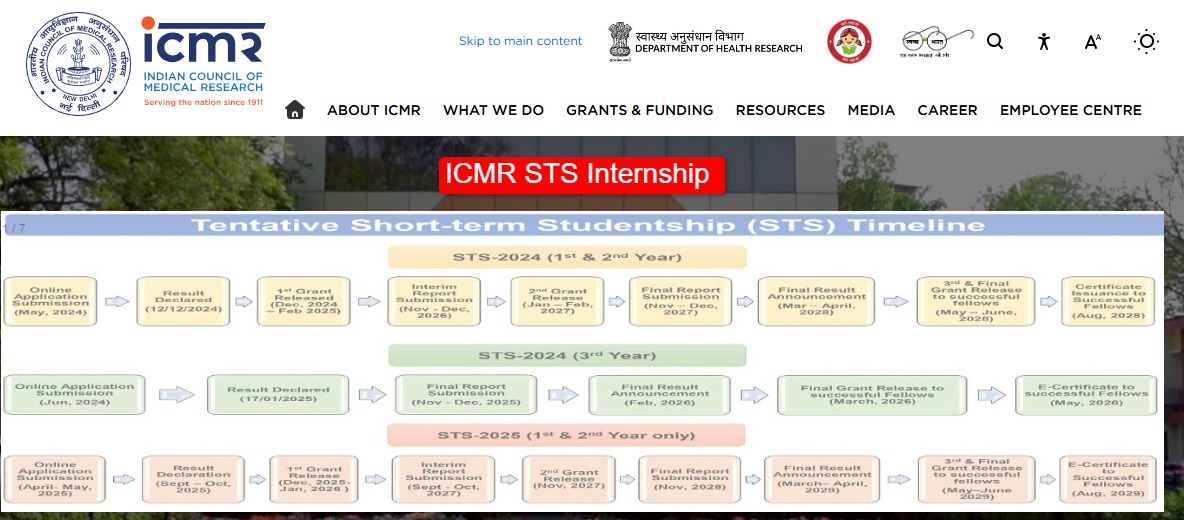
What Is ICMR STS?
The Short Term Studentship (STS) is an annual programme by the Indian Council of Medical Research (ICMR) under the Department of Health Research (DHR). It gives undergraduate medical and dental students a chance to conduct a real, faculty-guided research project in biomedical or health sciences.
This is not a certificate course. Not a virtual internship. You design a research study, collect data, analyze results, and submit a proper research report — the same way a scientist would.
The goal is to build a strong foundation in research early in medical education and develop future clinician-scientists in India.
The programme has been running for decades and ICMR’s name carries significant weight — both for MD/MS admissions and for anyone considering a research career in medicine or public health.
Quick Overview
| Feature | Details |
|---|---|
| Programme | Short Term Studentship (STS) 2026 |
| Offered By | ICMR / Department of Health Research (DHR) |
| Eligible Students | 1st and 2nd year MBBS / BDS |
| Stipend | ₹60,000 (on report approval) |
| Duration | Minimum 8 weeks |
| Application Mode | Online — schemes.dhr.gov.in |
| Last Date | 30 May 2026 — 5:00 PM |
| Certificate | ICMR digital certificate after report approval |
Stipend — ₹60,000 or ₹20,000?
There is confusion online about this. Different sources mention different numbers.
Selected students will receive a total stipend of ₹60,000 for completing the research project.
This is the current 2026 figure confirmed from the official notification. The ₹20,000 figure appearing on some older pages reflects previous years — the amount has been revised upward.
Important: The stipend is paid after your final report is reviewed and approved by ICMR. Not at selection. Not at submission. After approval.
Who Can Apply — Eligibility
This programme has strict eligibility. Read carefully before spending time on your proposal.
Who is eligible:
- Currently enrolled in 1st or 2nd Professional MBBS at an NMC-recognized Medical College
- Currently enrolled in 1st or 2nd year BDS at a DCI-recognized Dental College
- Must be in this stage before appearing for final professional exams
Year-wise research window:
- 1st year students can conduct research spanning 1st to 3rd Professional years
- 2nd year students can conduct research from 2nd to 4th Professional years
Who is NOT eligible:
- 3rd and 4th Professional MBBS/BDS students
- Interns
- PG students (MD/MS/MDS etc.)
- Students in paramedical or non-medical courses
One more requirement: You must have a faculty guide from your own institution who meets ICMR’s eligibility criteria for guides. No guide = no application.
⚠️ The Guide is Not Optional
A lot of students start thinking about their research topic without first confirming they have a guide. ICMR STS requires a qualified faculty mentor from your own recognized medical or dental college. Your guide’s details are part of the proposal — you cannot submit without them. Find your guide first. Discuss your topic with them. Then write the proposal together. Starting with the topic and searching for a guide later is backwards and usually runs out of time.
What Your Research Proposal Must Include
The proposal is the core of your application. Weak proposals get rejected — and this programme is competitive.
Your proposal should cover:
- Title — specific, not vague. “A study on diabetes” is bad. “Prevalence of undiagnosed Type 2 Diabetes among adults aged 30–50 in urban Pune: a cross-sectional study” is good.
- Background and rationale — why this topic matters and what gap you are addressing
- Objectives — 2 to 3 clear, measurable objectives
- Methodology — study design, sample size, data collection method, tools used
- Timeline — how you will complete this in 8 weeks
- Ethics — whether ethics approval is needed and your plan to get it
- Guide details — name, designation, institution, contact
Length: 300 to 500 words for the proposal body. Precise and specific beats long and vague every time.
💡 Ethics Approval — Start This Now, Not Later
If your study involves human subjects — patients, volunteers, survey respondents — you need ethics committee approval from your institution. This is mandatory. ICMR will not accept proposals involving human or animal subjects without it. Ethics approval from college committees can take 2 to 4 weeks. If you have not applied for it yet — do that today, in parallel with writing your proposal. Waiting for approval before submitting will cause you to miss the May 30 deadline.
How to Apply — Step by Step
Step 1: Go to the official DHR portal
Visit: schemes.dhr.gov.in
This is the official ePMS portal of the Department of Health Research. Do not use any other link.
Step 2: Register on the portal
Create a student account with your personal email and mobile number. Keep your login credentials safe — you will need them to submit your report later if selected.
Step 3: Fill in Part A — Student Details
Your personal information, college name, year of study, NMC/DCI registration of your college, and contact details.
Step 4: Fill in Part B — Research Proposal
Your research proposal goes here. Guide details are also entered in this section. Your guide may need to electronically verify or confirm their participation on the portal — confirm this with your guide before the deadline.
Step 5: Fill in Part C — Bank Details
Your single-holder bank account details and a scanned cancelled cheque. The stipend is paid via RTGS/NEFT directly to this account after report approval. Use your own individual account — joint accounts are not accepted.
Step 6: Submit before May 30, 5:00 PM
Late submissions will not be accepted under any circumstances.
Submit at least 2 to 3 days before the deadline. Portal traffic spikes near deadlines and submissions sometimes fail due to server load.
⚠️ Do Not Submit on May 30
Every year students lose their slot because they try to submit on the last day and the portal is slow or down. Submit by May 27 at the latest. If something goes wrong — a document upload fails, your guide has not confirmed, your bank details are wrong — you have time to fix it. May 30 at 4:59 PM with a portal error means you missed it. There is no extension.
Selection Process
- ICMR reviews all submitted proposals for feasibility, ethical soundness, and research quality
- Selected proposals are announced on the portal — check your registered email and the DHR website
- Selected students conduct their research under their guide’s supervision for a minimum of 8 weeks
- Final report is submitted through the portal within the specified window
- ICMR reviews the report — if approved, stipend is transferred and certificate is issued
Only students with both an approved proposal AND an accepted final report receive the certificate and stipend. Getting selected is step one — submitting a good final report is step two.
What You Get — Beyond the Stipend
The ₹60,000 is the obvious benefit. Here is what matters more for your career:
ICMR certificate — downloadable e-certificate after report approval. ICMR’s name on a certificate at undergraduate level is significant — it signals genuine research exposure.
Research publication possibility — strong STS projects sometimes get published in journals with your guide’s support. A publication in 1st or 2nd year MBBS is exceptional for any further application.
MD/MS admission advantage — many medical colleges and universities value research experience at the MBBS level. An ICMR STS certificate is a concrete, verifiable proof of that experience.
Skills you will not get from MBBS curriculum — research proposal writing, literature review, biostatistics, data collection, scientific writing, ethics compliance. These are skills that most MBBS graduates do not have.
Topic Ideas — What Gets Selected
ICMR does not restrict topics to specific areas, but certain types of proposals tend to be stronger:
- Community medicine / Public health — prevalence studies, KAP (Knowledge Attitude Practice) studies, nutritional surveys
- Microbiology — antibiotic resistance patterns, infection prevalence in specific populations
- Pharmacology — drug use pattern studies, adverse drug reaction monitoring
- Biochemistry — biomarker studies in specific disease populations
- Epidemiology — disease burden studies in specific demographics
What gets rejected: vague topics, proposals requiring expensive equipment unavailable at your institution, studies that cannot be completed in 8 weeks, and studies involving human subjects without ethics clearance planned.
Keep the scope tight. A well-executed small study is better than an ambitious study with weak data.
Important Dates
| Activity | Date |
|---|---|
| Application Open | Already open |
| Last Date to Apply | 30 May 2026 — 5:00 PM |
| Results | Announced on portal (typically 2–3 months after deadline) |
| Research Period | Minimum 8 weeks — as per academic calendar |
| Report Submission | As per ICMR timeline after selection |
| Stipend Transfer | After report approval |
Official Links
| Resource | Link |
|---|---|
| Apply Here (DHR ePMS Portal) | schemes.dhr.gov.in |
| ICMR STS Official Page | icmr.gov.in/short-term-studentship-sts |
| ICMR Official Website | icmr.gov.in |
| ICMR ePMS | epms.icmr.org.in |
Next Steps — What To Do Today
If you have not started yet:
- Find a guide today — talk to a faculty member in your department who does research
- Decide your topic together — keep it feasible for 8 weeks with your college’s resources
- Apply for ethics approval if your study involves human subjects — do this in parallel
- Start writing the proposal — 300 to 500 words, specific objectives, clear methodology
- Open schemes.dhr.gov.in and create your account
- Keep your bank details and cancelled cheque ready before you start filling the form
- Submit by May 27 — do not wait for May 30
The deadline is May 30. That is 15 days. A focused student can put together a strong proposal in 3 to 4 days if they have a clear topic and a cooperative guide.
Frequently Asked Questions
What is ICMR STS 2026? ICMR Short Term Studentship is an annual research programme by the Indian Council of Medical Research that allows 1st and 2nd year MBBS/BDS students to conduct a faculty-guided research project and receive a stipend and certificate on completion.
What is the last date for ICMR STS 2026? May 30, 2026 at 5:00 PM. Late submissions are not accepted under any circumstances.
What is the stipend for ICMR STS 2026? ₹60,000 — paid after the final research report is reviewed and approved by ICMR.
Can 3rd year MBBS students apply for ICMR STS? No. Only 1st and 2nd Professional MBBS/BDS students are eligible. 3rd and 4th year students, interns, and PG students are not eligible.
Is a faculty guide mandatory for ICMR STS? Yes. A qualified faculty guide from your own NMC/DCI recognized institution is mandatory. You cannot submit a proposal without guide details.
Do I need ethics approval for my ICMR STS project? Ethics approval is mandatory for studies involving human subjects or animals. Start this process immediately — it takes weeks and cannot be rushed.
Where do I apply for ICMR STS 2026? Through the official DHR ePMS portal at schemes.dhr.gov.in — not through any other website.
When will ICMR STS 2026 results be announced? Typically 2 to 3 months after the application deadline. Check the portal and your registered email regularly.
Can two students do the same STS project together? STS is typically individual — one student per project. Confirm on the portal for current rules.
What happens after my final report is submitted? ICMR reviews the report. If approved, the ₹60,000 stipend is transferred to your registered bank account via RTGS/NEFT and a digital certificate is issued.
I am particularly interested in gaining hands-on experience in areas such as immunology/virology and laboratory research. I am enthusiastic about applying my academic knowledge to real-world research and contributing meaningfully to ongoing projects