
Most students spend years studying global economics, public policy, and international development. Very few get to work on it — at the actual organization that shapes those policies for 38 countries.
The OECD Internship 2026 is one of those rare opportunities. You work inside the Organisation for Economic Co-operation and Development in Paris — the institution behind global standards on tax, education, climate, AI governance, and economic policy.
This isn’t a coffee-fetching internship. You support Policy Analysts on live research, contribute to working papers, and sit in rooms where international standards get drafted.
Applications are open on a rolling basis until 31 December 2026. Here’s everything you need to know before applying.
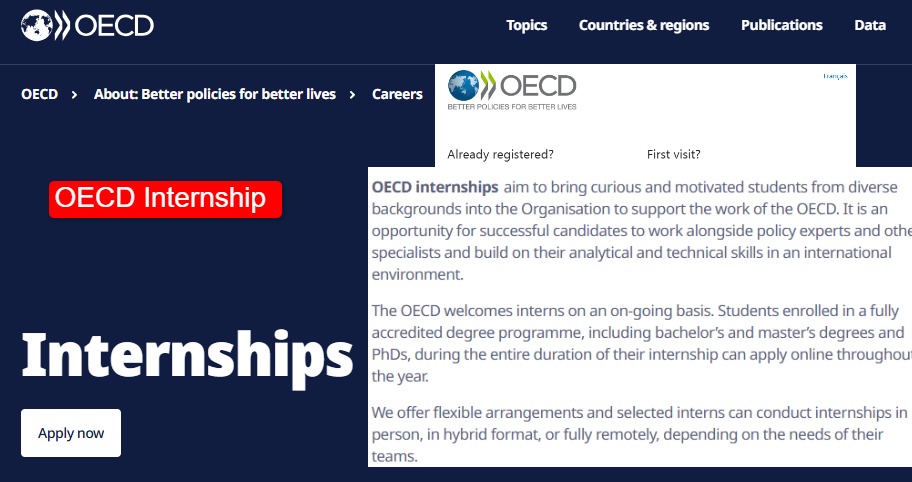
Quick Highlights
| Feature | Details |
|---|---|
| Organization | OECD — Organisation for Economic Co-operation and Development |
| Location | Paris, France |
| Duration | 1 to 6 months (renewable up to 12 months) |
| Stipend | As per OECD intern compensation rules (confirm on portal) |
| Application Mode | Online — Rolling basis |
| Application Deadline | 31 December 2026 |
| Languages Required | English and/or French |
| Who Can Apply | Full-time students enrolled in a degree programme |
| Selection Timeline | Up to 3 months after application |
| Apply At | careers.smartrecruiters.com/OECD |
What Is the OECD?
The Organisation for Economic Co-operation and Development is an international body with 38 member countries. Its job is to build better policies for better lives — working with governments, researchers, and institutions across the world.
Every major global conversation about tax reform, education quality, digital regulation, climate policy, or economic inequality has OECD research somewhere in its foundation.
When you intern here, you’re not supporting a corporate department. You’re contributing to work that feeds into actual government decisions across dozens of countries.
What Will You Actually Work On?
This is the part most articles skip. The OECD internship is not a fixed-role position. You’re placed within a specific Directorate based on your background, availability, and the organisation’s current needs.
Policy and Research Areas
Interns support Policy Analysts across a wide range of work areas:
- Agriculture and Fisheries
- Artificial Intelligence
- Bribery and Corruption
- Competition Policy
- Corporate Governance
- Development and Development Effectiveness
- Digitalisation
- Economy
- Education and Skills
- Employment
- Energy
- Environment
- Ethics
- Finance
- Gender and Diversity
- Global Relations
- Health
- Industry, Innovation and Entrepreneurship
- Insurance and Pensions
- International Migration
- Investment
- Monitoring and Evaluation
- Nuclear Energy
- Public Governance
- Regional Development
- Regulatory Reform
- Science and Technology
- Statistics
- Tax
- Tourism
- Trade and Agriculture
- Transport
Corporate Function Areas
If your background is in operations, communications, or technology rather than policy, you can be placed in:
- Communications, Media and Public Relations
- Event Management
- Finance, Budget and Accounting
- Human Resources
- Information Technology
- Legal Services
- Office Administration
- Translation
Day-to-Day Work Examples
What interns actually do:
- Researching and reviewing existing materials for ongoing studies
- Collecting, organising, and analysing data
- Contributing to working papers, technical annexes, and publications
- Drafting notes and briefing documents
- Attending and participating in meetings and seminars
- Liaising with officials in national administrations and other international organisations
- Supporting event organisation, communications planning, and evaluation
💡 Pro-Tip: Choose Your Area Before You Apply
The OECD application asks you to indicate your area of interest. Don’t leave this vague. Look at the list above and pick the one that genuinely aligns with your academic background and thesis or research work. Directorates shortlist based on fit — a generic “interested in everything” approach weakens your application against someone who clearly connects their Economics degree to the Tax or Development Effectiveness team. Be specific. Your cover letter and your area selection should tell the same story.
Eligibility Criteria
The OECD keeps eligibility criteria fairly straightforward — but there are specific requirements that eliminate a lot of applicants early.
Academic Background
- Must be a full-time student enrolled in a degree programme for the entire duration of the internship
- The field of study must be related to the work of the OECD
- No specific degree level is stated — Masters students tend to have stronger applications, but the programme does not officially exclude Bachelor’s students
Language Requirements
- Fluency in English and/or French — these are the two official OECD languages
- Knowledge of both is an advantage
- Commitment to reaching a good working level in the second language is expected
Professional Background
- International experience through studies, internships, or professional activities is an asset — not a requirement
Skills and Competencies
- Strong analytical and research skills
- Solid quantitative and computer skills; Microsoft Office proficiency
- Strong drafting and communication skills
- Ability to work independently on research tasks
- Comfortable in a multicultural, team-oriented environment
- Good organisational skills under tight deadlines
Eligibility Checklist
| Criteria | Requirement |
|---|---|
| Student Status | Full-time enrolled for internship duration ✅ |
| Field of Study | Related to OECD work areas ✅ |
| Language | English and/or French fluency ✅ |
| Analytical Skills | Demonstrated through academic record ✅ |
| Computer Skills | Microsoft Office proficiency ✅ |
| International Experience | Asset, not mandatory ✅ |
⚠️ Common Pitfall: Applying While on Study Break or Between Semesters
The OECD requires you to be a full-time enrolled student for the entire duration of the internship. This is a hard requirement — not a formality. If you’re between degrees, on a gap year, or have already graduated by the time the internship starts, you will not be eligible. The selection process takes up to three months, so plan your application timeline carefully. Apply while you’re still enrolled, and ensure your internship period falls within your active enrolment window.
Duration and Contract Details
- Minimum: 1 month
- Maximum: 6 months per contract
- Renewable: Up to a total of 12 months
- Recruitment: Rolling basis — no fixed intake cycles
This flexibility is deliberate. Different Directorates have different project timelines and hiring needs. Some teams bring in interns for a focused 2-month sprint on a specific report. Others need 6-month placements for longer research projects.
When you apply, you indicate your availability dates. Your placement — if selected — is matched to a team that needs someone in that window.
How to Apply for the OECD Internship
The application is entirely online through the OECD’s careers portal. There are no paper forms, no postal submissions, and no separate registration steps.
Step 1: Go to the Official Portal
Visit: careers.smartrecruiters.com/OECD/internships—en
Click on the Internship Programme listing.
Step 2: Fill in the Application Form
The application has two parts:
- Part 1: Personal information, academic background, and work experience
- Part 2: Screening questions to determine eligibility
Important: At least one entry must be saved under both the Experience section and the Education section before you can submit. Even if your experience is limited, add your most relevant academic project, volunteer work, or part-time role.
All fields marked with an asterisk (*) are required. Review every field before submitting — errors cannot always be corrected after submission.
Step 3: Attach Your Resume
A resume must be attached. No resume, no application — it’s that simple.
Keep it to 1–2 pages. Prioritise:
- Relevant academic projects and thesis work
- Research experience
- International exposure (exchange programmes, conferences, publications)
- Language skills
Step 4: Write Your Cover Letter
In the application form, this appears as “Message to Hiring Manager.”
The OECD is specific about what they want from this section:
- Why you want to intern at the OECD specifically
- How you would contribute to their work
- How this internship helps you achieve your career goals
Limit: 3,500 characters including spaces. That’s roughly 500–600 words. Be precise. Don’t use this space to repeat your resume.
Step 5: Indicate Your Availability
Clearly state when you are available to start and how long you can commit. Vague availability (“flexible”) is less useful to hiring teams than specific dates (“available from 1 September 2026 for 4 months”).
Step 6: Submit and Wait
The selection process takes up to three months. You will only be contacted if shortlisted by a specific Directorate. The OECD does not provide individual feedback due to application volume.
If you haven’t heard back within six months, you can update your application and reapply using the same email address.
⚠️ Common Pitfall: Applying Once and Forgetting
The OECD receives a very high volume of applications. Not hearing back within three months is common — it doesn’t necessarily mean rejection. It often means no team had an opening that matched your profile and availability at that moment. The official guidance says: if six months pass with no response, update your application and reapply. Many successful interns applied more than once before being shortlisted. Treat it like a research project — persistent, systematic, and not personalised around a single attempt.
Application Deadline
Applications are accepted until 31 December 2026, after which a new vacancy will be published for the next cycle.
Since this is rolling, there is no single “best time” to apply — but earlier is always better. Teams fill positions based on current project needs. A position that exists today may not exist three months from now.
Apply as soon as your application is ready. Do not wait for a specific intake window.
Why the OECD Internship Stands Out
Let’s be practical about what makes this different from other international internships.
1. The Name OECD on a resume opens doors in international organisations, government ministries, think tanks, central banks, and multilateral institutions. It is one of the most recognised names in global policy.
2. The Work You contribute to actual research that gets published, cited, and used by governments. This is not observational. You produce deliverables that go into real OECD outputs.
3. The Network Working alongside economists, policy analysts, and officials from 38 member countries builds a professional network that most people spend decades trying to access.
4. Paris The OECD headquarters is in Paris. For international students, six months working in Paris — in a multilingual, multicultural professional environment — is a significant personal and professional experience.
5. Flexibility The rolling recruitment and variable duration means you can find a placement that fits your academic calendar rather than forcing your calendar around a fixed intake.
Official Links
| Resource | Link |
|---|---|
| OECD Internship Portal | careers.smartrecruiters.com |
| OECD Official Website | oecd.org |
| Internship FAQs (Official PDF) | OECD-Internship-PDF |
| People Management Guidebook | issuu.com |
Next Steps: What To Do Right Now
- Read the official FAQ PDF at oecd.org/careers/OECD-Internship-FAQs.pdf — it answers specific questions about compensation, visa support, and housing that are not covered in the job listing
- Decide your area — pick one or two work areas from the list that genuinely match your academic background
- Update your resume — focus on research experience, analytical projects, and language skills
- Draft your cover letter — specifically address why OECD, what you’ll contribute, and how it fits your career goals. Keep it under 3,500 characters
- Check your enrollment status — confirm you will be a full-time enrolled student for your entire intended internship period
- Apply now — do not wait for a “better time.” Rolling recruitment means the best time is when a team needs someone with your profile
The deadline is 31 December 2026 — but positions fill on a rolling basis. Applying in November is not the same as applying today.
Frequently Asked Questions
Q1. What is the OECD Internship 2026? It is a structured internship at the Organisation for Economic Co-operation and Development in Paris, France. Interns support Policy Analysts across research, data analysis, and policy areas covering 30+ disciplines. Applications are open on a rolling basis until 31 December 2026.
Q2. Is the OECD internship paid? The OECD provides compensation to interns as per its internal rules. The exact amount is not published in the job listing — check the official FAQ PDF at oecd.org/careers/OECD-Internship-FAQs.pdf or contact the OECD Internship Office directly for current figures.
Q3. Who is eligible for the OECD internship? Full-time students enrolled in a degree programme for the duration of the internship, in a field related to OECD work. Fluency in English and/or French is required. The programme is open to students from all nationalities.
Q4. How long is the OECD internship? Between 1 and 6 months per contract, renewable up to a total of 12 months. Duration depends on the hosting Directorate’s needs and your availability.
Q5. When is the last date to apply for OECD internship 2026? 31 December 2026. However, since recruitment is rolling, positions fill throughout the year. Apply as early as possible — do not wait for the deadline.
Q6. How long does the OECD selection process take? Up to three months from application submission. Only shortlisted candidates are contacted. If you haven’t heard back in six months, you can update and reapply.
Q7. Can Bachelor’s degree students apply? The listing requires enrolment in a degree programme related to OECD work — it does not specify Master’s only. However, Master’s and PhD students tend to be more competitive given the analytical nature of the work.
Q8. Is French mandatory for the OECD internship? Fluency in English and/or French is required. Both is an advantage. If you’re fluent in English but not French, you can still apply — the listing asks for a commitment to reach a good working level in the other language.
Q9. Where is the OECD internship located? Paris, France. This is an in-person position at OECD headquarters. Remote arrangements are not mentioned in the current listing.
Q10. Can I apply more than once? Yes. If you haven’t been contacted within six months of applying, you can update your application and reapply using the same email address. Multiple applications across different cycles are common among successful candidates.